
What if an ancient epic could make an audience laugh, think and see everyday life from a different perspective?
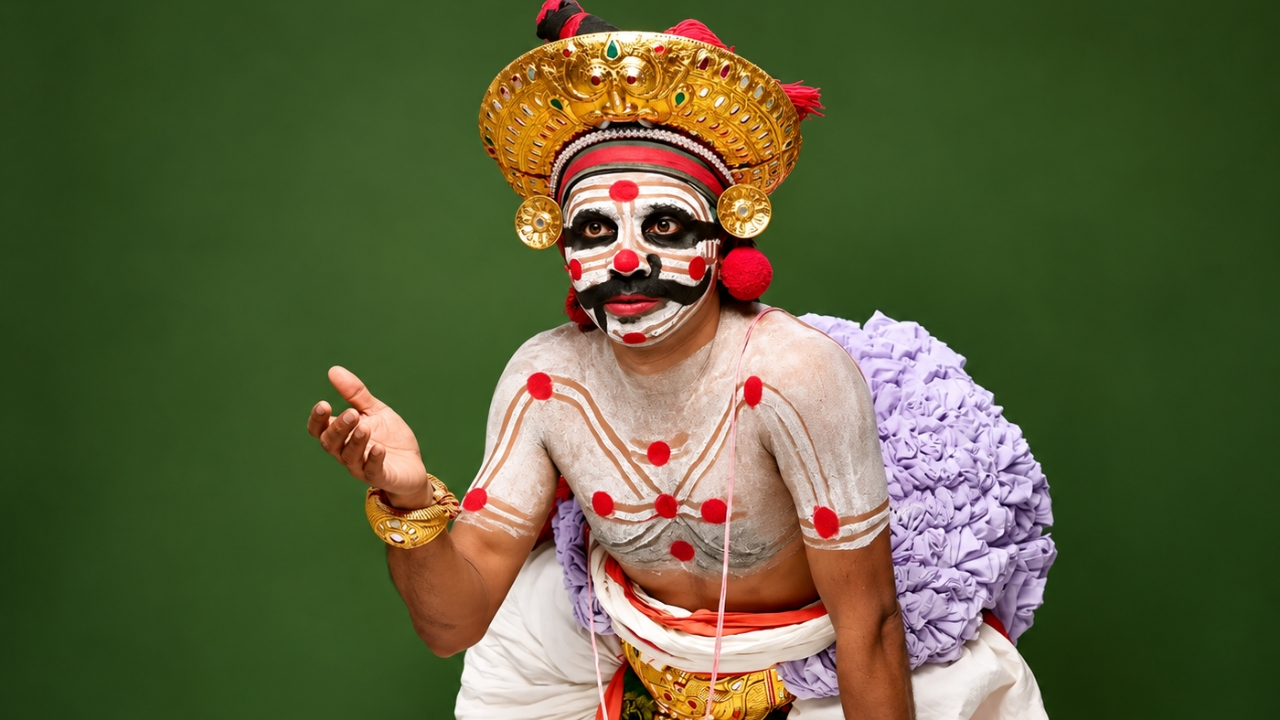
That is the distinctive appeal of Chakyar Koothu, a traditional performing art of Kerala closely associated with Kutiyattam, the state’s Sanskrit theatre tradition. Unlike performance forms that depend heavily on elaborate choreography, Chakyar Koothu places the spotlight on a single performer, whose storytelling, voice, facial expressions, gestures and humour carry the narrative.
The stories often come from the Ramayana, Mahabharata and Puranic literature, but the performance goes beyond simply recounting ancient events. Through Malayalam narration and satire, the artist can interpret the story and connect its characters and situations with human behaviour and contemporary life.
For travellers interested in Kerala’s cultural heritage, Chakyar Koothu offers a glimpse into a form of theatre where literature, performance and humour come together.
What Is Chakyar Koothu?
Chakyar Koothu is traditionally the male solo form of Koothu, a performance tradition associated with Kerala’s Kutiyattam theatre.
The performer traditionally appears as the Vidushaka, the comic or jester-like figure of Sanskrit theatre. Rather than relying on a large cast, the artist carries the performance through narration, oratory, gestures and expressive acting.
The performer’s ability to communicate with the audience is central to the art. A change in voice, expression or timing can introduce a new character, emotion or humorous observation.
Although Chakyar Koothu has historical roots in specific performer communities and temple traditions, the art is also being learned and presented by artists beyond those traditional communities today.
Stories From the Epics
The literary foundation of Chakyar Koothu comes largely from classical Sanskrit literature and stories from the Ramayana and Mahabharata.
The performer recites or refers to Sanskrit verses and then explains, expands and interprets the story in Malayalam. This makes the performance more than a simple narration of an epic episode.
A familiar mythological character may become the starting point for discussing pride, ambition, relationships, social customs or human behaviour.
This ability to move between ancient literature and everyday observation is one of the reasons Chakyar Koothu remains engaging even for audiences encountering it for the first time.
Why Humour and Satire Matter
Humour is one of the defining characteristics of Chakyar Koothu.
The Vidushaka gives the performer space to comment on people, customs and social behaviour while presenting a traditional story. Depending on the performer and context, the humour can include wordplay, teasing, irony and sharper social commentary.
The result is unusual: the audience can listen to a story rooted in mythology while hearing observations that relate much more closely to ordinary life.
In this sense, Chakyar Koothu does not treat the past as something completely separate from the present. It uses the past as a way of looking at the present.
Champu Prabhashan: Prose and Poetry
Another important feature is Champu Prabhashan, a style that combines prose and poetry.
The performer can move between Sanskrit verses, Malayalam explanation and spoken commentary. This gives the narration a flexible structure and allows the artist to expand on individual scenes and characters.
For a viewer, this means the performance is as much about how the story is told as the story itself.
The language, voice and timing of the performer become part of the drama.
Mizhavu and Traditional Accompaniment
Chakyar Koothu is traditionally accompanied by Mizhavu, a large copper percussion instrument strongly associated with Kerala’s Kutiyattam and Koothu traditions.
The Mizhavu provides a deep rhythmic foundation for the narration. Cymbals also form part of the traditional accompaniment.
The instruments support the performance rather than overwhelming the storyteller, keeping attention focused on the narration and dramatic expression.
Koothambalam: The Traditional Stage
Chakyar Koothu has a long association with Kerala’s temple culture and was traditionally performed in Koothambalams, the theatre spaces designed for temple performance traditions such as Kutiyattam and Koothu.
This setting is an important part of the art form’s history. The performance developed within a cultural and religious environment rather than as a modern stage show created primarily for entertainment.
Today, related performance traditions are also presented in cultural institutions, festivals and other venues, allowing a wider audience to experience them.
Chakyar Koothu and Nangiarkoothu
Koothu includes two important traditional forms: Chakyarkoothu and Nangiarkoothu.
Chakyarkoothu is traditionally the male solo form, while Nangiarkoothu is the female solo form associated with the wider Kutiyattam tradition.
Nangiarkoothu has its own distinct repertoire and performance style. It is particularly associated with Sree Krishna Charitham, focusing on episodes from the life of Lord Krishna.
One notable technique is Pakarnnattam, through which a single performer takes on different characters using changes in expression and performance.
Understanding this distinction helps visitors appreciate that Kerala’s Koothu heritage is broader than Chakyar Koothu alone.
Where Can You Explore This Tradition?
For travellers interested in Kerala’s traditional theatre, central Kerala is an important region to explore.
Thrissur and Irinjalakuda have strong connections with Kerala’s temple and performing-arts traditions, while Cheruthuruthy is well known for Kerala’s broader performing-arts heritage.
In Thiruvananthapuram, institutions such as Margi Theatre are associated with the teaching and presentation of traditional forms including Chakyarkoothu, Kutiyattam and Nangiarkoothu.
However, visitors should not assume that Chakyar Koothu is performed daily. Traditional performances may be connected to temple festivals, cultural programmes or specific schedules.
If seeing a performance is an important part of your itinerary, check with the relevant temple or cultural institution before travelling.
What Should a First-Time Visitor Notice?
For someone seeing Chakyar Koothu for the first time, the most interesting part may not be the stage itself but the performer’s ability to control the audience through words and expression.
Pay attention to:
- How the performer shifts between Sanskrit verses and Malayalam narration
- Changes in facial expression and voice
- The use of humour within a mythological story
- The rhythm created by the Mizhavu and cymbals
- How an ancient episode becomes connected to everyday life
These details help explain why Chakyar Koothu is considered a distinctive form of storytelling rather than simply another dance performance.
Why Chakyar Koothu Still Matters
Chakyar Koothu demonstrates how a traditional art form can preserve ancient literature while continuing to speak to contemporary audiences.
A story from the Mahabharata can become a humorous observation about human behaviour. A Sanskrit verse can lead into a Malayalam explanation. A temple performance can become an opportunity for social commentary.
That combination of mythology, language, theatre, humour and satire is what makes Chakyar Koothu an important part of Kerala’s living cultural heritage.
Final Thoughts
Chakyar Koothu offers travellers a different way to understand Kerala.
Instead of discovering the state only through its backwaters, beaches, food and landscapes, you can also discover it through the stories that have been performed and passed down across generations.
With its connection to Kutiyattam, Koothambalam, Sanskrit literature, Mizhavu and the Vidushaka tradition, Chakyar Koothu represents a remarkable meeting point between classical theatre and spoken storytelling.
If your Kerala journey includes an interest in culture and heritage, take the time to explore its traditional performing arts. Sometimes, the most memorable part of a journey is not the place you photograph, but the story you hear there.
Explore Kerala’s culture, traditions and heritage with KeralaPackageTours and discover a side of the state that goes beyond sightseeing.


