
You can travel across Kerala without leaving the dining table.
The flavours change as the landscape changes. Along the coast, fresh fish and seafood meet coconut, curry leaves and spices. In central Kerala, rice, vegetables and elaborate feasts are deeply woven into everyday life and celebrations. In the north, the food becomes more closely associated with the distinctive flavours of Malabar cuisine, from biryani and pathiri to seafood and traditional snacks.
Then there is Sadya—a feast where a simple banana leaf becomes a table filled with colours, textures and flavours.
Kerala cuisine is not one fixed menu. It has been shaped by the state’s geography, locally available ingredients, communities, traditions and centuries of contact with other cultures. Kerala Tourism itself highlights the state’s food through categories including Sadya, breakfast, rice dishes, seafood, Malabar cuisine, tribal cuisine, snacks, desserts and Christian cuisine.
So, what should you actually taste when you travel through Kerala?
The answer becomes more interesting when you look at the food not simply as a list of dishes, but as part of the places, people and traditions that created them.
What Makes Kerala Cuisine Different?
A Kerala kitchen often starts with ingredients that may look simple on their own but become remarkably different when combined.
Coconut, rice, curry leaves, ginger, garlic, turmeric, black pepper, green chilli and other spices form the foundation of many traditional preparations. Coconut can be grated, ground into a paste, roasted or turned into coconut milk, giving the same ingredient several different roles in the kitchen.
Rice is just as important.
It appears not only as cooked rice but also in dishes such as puttu, appam, idiyappam, pathiri and dosa. Kerala’s long coastline and extensive network of rivers and backwaters also contribute to a strong fish and seafood tradition.
But perhaps the most interesting thing about Kerala food is its variation.
A dish prepared in Thiruvananthapuram may taste different from one prepared in Kozhikode. A Sadya in the north may not be identical to one in the south. Even the same fish curry can change depending on the region, ingredients and cooking tradition.
Kerala Tourism notes that culinary variations can differ from district to district, with the same dish appearing in different forms across the state.
That diversity is what makes exploring Kerala through food so rewarding.
Sadya: The Feast That Brings Kerala Together

If there is one meal that deserves to be experienced rather than simply described, it is Sadya.
Traditionally served on a plantain leaf, Sadya brings together rice, curries, vegetables, pickles, savouries and desserts. Kerala Tourism describes a traditional Sadya as a vegetarian feast that can include up to 28 dishes.
The experience is about more than quantity.
The leaf gradually fills with dishes such as parippu, sambar, avial, thoran, olan, pachadi, kichadi, kaalan, pickles, banana chips and pappadam. At the end comes one of the most anticipated parts of the meal—payasam.
There is also a traditional order to the meal. Different dishes are served at different stages, allowing sweet, sour, spicy and savoury flavours to balance one another.
Sadya is especially associated with Onam, but it also appears during weddings, religious occasions and other celebrations.
For a traveller, eating Sadya is one of the easiest ways to understand how food, hospitality and community come together in Kerala.
Southern Kerala: Coconut, Rice and Comforting Flavours
Travel towards Thiruvananthapuram, Kollam and the southern parts of Kerala, and you begin to encounter a culinary style where coconut and coconut milk feature prominently in many dishes.
Vegetarian preparations such as avial, olan, thoran, pulissery and pachadi demonstrate how vegetables, coconut and spices can create very different flavours from relatively simple ingredients.
Then there is appam and stew.
The soft, fermented rice pancake has a delicate centre and lightly crisp edges, while the accompanying stew can be prepared with vegetables, chicken or other ingredients in a coconut-milk-based gravy.
It is a combination that works particularly well for breakfast, but its appeal goes beyond the morning meal.
Southern Kerala’s cuisine is a reminder that traditional food doesn’t always need intense heat to be full of flavour.
Central Kerala: Food Shaped by Land, Water and Community
Move towards Kottayam, Alappuzha, Kumarakom and Kochi, and the relationship between food and landscape becomes particularly noticeable.
The backwaters, rivers, paddy fields and coastal environment have all contributed to the region’s food culture. Rice remains central, while fish and seafood are common features of meals across the waterways and coastal areas.
Karimeen, or pearl spot, is particularly associated with Kerala’s backwater regions. It can be prepared in several ways, including the much-loved karimeen pollichathu, where the fish is cooked with a spiced masala and traditionally wrapped in a banana leaf.
Central Kerala is also home to culinary traditions associated with different communities, including Kerala’s Christian communities, whose food traditions include elaborate dishes prepared for feasts, family gatherings and special occasions. Kerala Tourism recognises Christian cuisine as a distinct part of the state’s wider culinary heritage.
This is one reason a journey through central Kerala can become a food journey of its own.
Malabar Cuisine: The Bold Flavours of Northern Kerala

Head north towards Kozhikode, Malappuram, Kannur, Wayanad and Kasaragod, and Kerala’s culinary landscape takes another turn.
This is the world of Malabar cuisine.
Kerala Tourism describes Malabar food as a distinctive regional tradition shaped by the influence of Arab, Brahmin, Chirakkal and Zamorin culinary cultures. Kozhikode and Thalassery are particularly recognised as centres of Malabar cuisine.
The first dish many travellers think of is Malabar biryani.
But there is much more to discover.
Try pathiri, ghee rice, Malabar parotta, erachi puttu, kallummakkaya dishes and regional seafood preparations.
The snack tradition is equally impressive. Unnakkaya, pazham nirachathu, chattipathiri, muttamala and arikadukka are among the foods associated with Malabar’s culinary identity.
And after a rich meal, a cup of Sulaimani tea offers a very different kind of finish.
If food is one of the reasons you travel, northern Kerala deserves more than a passing visit.
Kerala's Seafood Tradition

With the Arabian Sea along its western coast and an extensive network of rivers and backwaters, Kerala has naturally developed a strong relationship with fish and seafood.
But there is no single Kerala fish curry.
Recipes change according to the region, fish, souring ingredients and cooking style. Coconut may be used in one preparation, while another may rely more heavily on chilli and spices.
Some dishes worth looking for include:
- Kerala fish curry
- Karimeen pollichathu
- Fish moilee
- Prawn curry
- Squid fry
- Crab preparations
- Mussel dishes
- Banana-leaf fish preparations
Kerala Tourism identifies fish curry, prawn curry, squid fry and karimeen pollichathu among the state’s well-known non-vegetarian specialities.
For travellers staying around Alappuzha, Kumarakom, Kochi or other coastal and backwater destinations, trying a locally prepared fish dish can be one of the most memorable parts of the trip.
Kerala Breakfast: Start the Day With Something Local
One of the easiest ways to experience Kerala cuisine is to forget the hotel buffet for a morning and try a traditional breakfast.
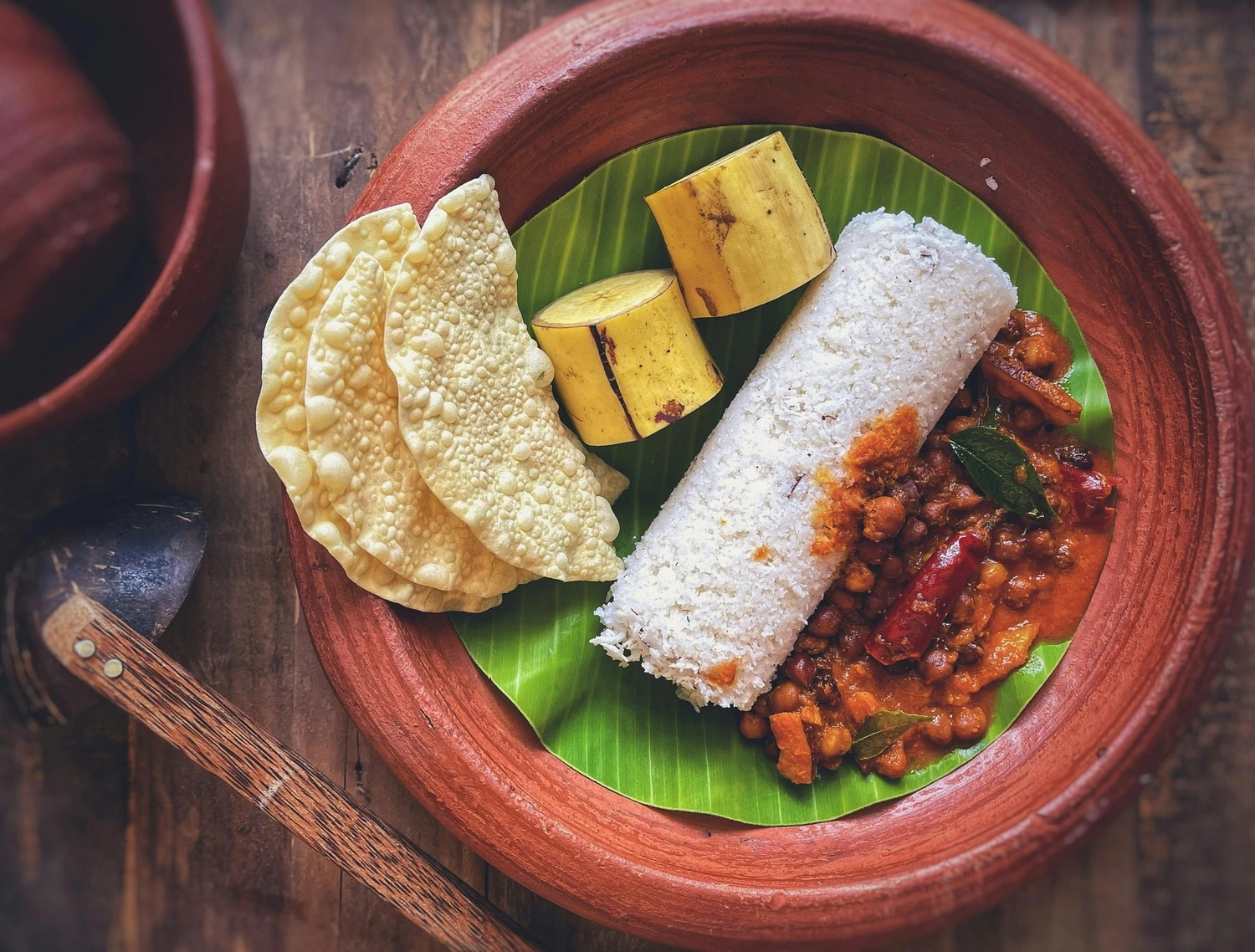
Start with puttu and kadala curry.
Puttu is made from steamed rice flour and coconut and is commonly paired with a spicy black chickpea curry.
Or try appam and stew, especially if you prefer a softer and more coconut-rich combination.
Other familiar Kerala breakfast dishes include:
- Idiyappam
- Pathiri
- Dosa
- Idli
- Kappa
- Vattayappam
These aren’t simply dishes prepared for tourists. They form part of everyday food culture across Kerala. Kerala Tourism includes puttu, appam, dosa, idli, idiyappam and pathiri among the state’s traditional breakfast foods.
For a first-time visitor, breakfast can actually be one of the best introductions to Kerala food because the dishes are often simple, filling and easy to recognise.
Kappa and Fish Curry: A Simple Kerala Classic
Some of Kerala’s most memorable food combinations are surprisingly uncomplicated.
Kappa and fish curry is a perfect example.
Boiled tapioca is paired with a strongly flavoured fish curry, creating a meal that is hearty, earthy and unmistakably Kerala.
It also illustrates something important about traditional cooking: local ingredients do not need complicated presentation to create a satisfying meal.
If you want to move beyond restaurant-style dishes and taste something closer to everyday Kerala food, kappa and fish curry is worth trying.
Kerala's Snacks: Small Bites With Big Regional Character
Food exploration doesn’t have to mean sitting down for a full meal.
Kerala has a strong tea-time snack culture, and small bakeries, tea shops and local eateries offer an easy way to experience it.
Try pazhampori, the familiar banana fritter, or parippu vada, a crisp savoury snack made with lentils.
In northern Kerala, the choices become even more distinctive, with unnakkaya, pazham nirachathu and chattipathiri offering flavours closely associated with Malabar.
Banana chips and other savoury snacks are also closely associated with Kerala’s food culture and are commonly found during festivals and celebrations.
Sometimes, sitting down with a cup of tea and a freshly prepared snack gives you a better glimpse of everyday food culture than an elaborate restaurant meal.
Kerala's Sweet Side: Payasam and Traditional Desserts
Kerala knows how to end a meal.
Payasam is perhaps the most recognisable traditional dessert, and there is far more than one version.
Depending on the preparation, you may encounter Pal Payasam, Palada Pradhaman, Ada Pradhaman, Kadala Payasam or other regional varieties.
Some use milk, while others rely on coconut milk and jaggery. Cardamom, nuts and raisins may add fragrance and texture.
Payasam is particularly important during Sadya and festive occasions, where it becomes part of the larger celebration rather than simply a dessert served after dinner.
Northern Kerala brings its own sweet traditions, including dishes such as muttamala and chattipathiri.
So if you have a sweet tooth, don’t stop after the main course.
Kerala's Tribal Cuisine: A Different Culinary Tradition
Kerala’s food story extends beyond the dishes commonly found in restaurants.
The state’s tribal communities have their own culinary traditions, ingredients and cooking methods. Kerala Tourism specifically highlights tribal cuisine as a distinct part of the state’s food heritage, including recipes that use rare ingredients and traditional preparation techniques.
These food traditions are closely connected to local environments and community knowledge.
For travellers, this is an important reminder that “Kerala cuisine” is much broader than the dishes commonly found on tourist menus.
Where authentic community-based experiences are available, they can offer a deeper understanding of the relationship between food, land and culture.
Where to Experience Kerala Cuisine During Your Trip
You don’t need to visit a high-end restaurant to eat well in Kerala.
In fact, some of the most memorable food experiences can come from local restaurants, small eateries, traditional homestays, Sadya establishments and responsible-tourism experiences.
Think about food according to your itinerary.
Kochi
A good place to explore different sides of Kerala cuisine, with traditional dishes alongside the city’s wider culinary influences.
Alappuzha and Kumarakom
Look for backwater-region fish dishes, karimeen preparations, Kerala meals and coconut-based curries.
Kottayam
A useful destination for experiencing central Kerala flavours and the culinary traditions associated with local Christian communities.
Kozhikode and Thalassery
Head here for Malabar biryani, pathiri, ghee rice, seafood and traditional Malabar snacks.
Kasaragod and North Kerala
Explore regional food traditions alongside the area’s distinctive cultural landscape.
The best approach is simple: ask what is locally prepared, try seasonal dishes and don’t be afraid to order something unfamiliar.
Final Thoughts
Kerala’s cuisine is not simply a collection of famous dishes. It is a reflection of the places, communities and traditions that have shaped the state over generations.
You can discover one side of Kerala through a banana-leaf Sadya, another through puttu and kadala curry, another through a seafood meal beside the backwaters, and yet another through Malabar biryani in northern Kerala.
That is what makes a food journey through Kerala so interesting.
Don’t come looking for just one signature dish. Come hungry enough to explore the flavours that change as you travel from one part of Kerala to another.
Plan your Kerala holiday with KeralaPackageTours.com and leave room in your itinerary not only for the places you visit, but also for the food that helps you understand them.

