
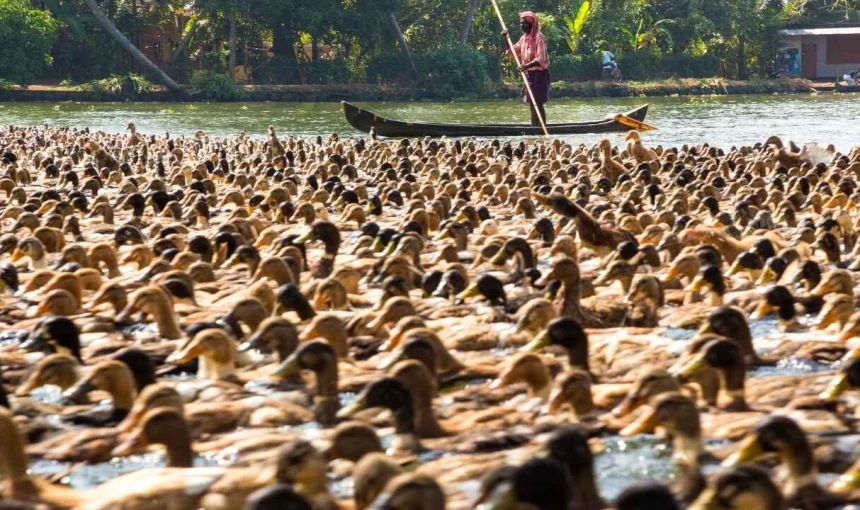
In Kuttanad, water is more than part of the scenery—it shapes the way people farm, travel, eat and live. Vast paddy fields stretch across low-lying wetlands, narrow canals connect villages, and traditional boats continue to move through a landscape where land and water exist side by side.
Known as the Rice Bowl of Kerala, Kuttanad is famous for its unusual below-sea-level farming system and beautiful backwaters. But its real character goes beyond houseboats and scenic views. Here, agriculture, fishing, village life and age-old traditions have developed around the water for generations.
If you want to discover a quieter and more authentic side of Kerala’s backwaters, Kuttanad offers a fascinating experience.
What Makes Kuttanad So Unique?

Kuttanad is one of Kerala’s most distinctive landscapes. Parts of its agricultural areas lie below sea level, allowing farmers to cultivate rice in reclaimed wetlands protected by bunds and water-management systems.
Kerala Tourism highlights Kuttanad’s below-sea-level landscape, while the Food and Agriculture Organization (FAO) recognizes the Kuttanad Below Sea Level Farming System as a Globally Important Agricultural Heritage System (GIAHS).
The landscape is shaped by:
- Extensive paddy fields
- Rivers and canals
- Backwaters and wetlands
- Coconut plantations
- Village settlements
- Fishing communities
- Traditional farming
- Boat transportation
This combination makes Kuttanad much more than another backwater destination.
The Rice Bowl of Kerala
Rice cultivation is at the heart of Kuttanad’s identity.
The region’s famous paddy fields create a striking contrast with the surrounding waterways. During the growing season, the fields turn vibrant green, while canals and coconut-lined bunds create natural pathways through the agricultural landscape.
The farming system is particularly remarkable because cultivation takes place in areas affected by surrounding water. Farmers have developed methods of constructing and maintaining bunds, managing water levels and protecting agricultural land.
The FAO recognizes this traditional farming system for its combination of agriculture, biodiversity, water management and local livelihoods.
For visitors, the paddy fields offer some of the most memorable landscapes in Kerala—but they are also working agricultural areas, not simply sightseeing spots.
Life Below Sea Level
The most fascinating part of Kuttanad’s story is how people adapted to its geography.
Instead of abandoning low-lying wetlands, generations of farmers reclaimed suitable areas and protected them using bunds. Water is carefully managed so that rice cultivation can take place.
This has created a landscape where farmland can sit lower than the surrounding water bodies.
The system requires continuous cooperation between farmers, waterways and water-management infrastructure. It is a remarkable example of how a community adapted its agricultural practices to an unusual environment.
This relationship between people and water is what makes Kuttanad different from many other agricultural regions.
Rivers and Backwaters That Shape Kuttanad

Water is everywhere in Kuttanad.
The wider region is influenced by major rivers including the Pamba, Achankovil, Meenachil and Manimala, along with the extensive Vembanad Lake backwater system.
These waterways have historically supported agriculture, fishing and transportation.
Today, they also form the foundation of Kuttanad’s tourism experience.
A journey through the backwaters reveals a constantly changing landscape of:
- Paddy fields
- Coconut palms
- Canals
- Small bridges
- Village homes
- Fishing boats
- Country boats
- Waterbirds
The scenery is beautiful, but watching everyday life unfold along the waterways is often even more interesting.
Kainakary: A Village Surrounded by Water
Kainakary is one of the places where visitors can experience Kuttanad’s characteristic combination of canals, paddy fields and village life.
Instead of large tourist attractions, the appeal lies in the landscape itself. Small boats move through waterways while homes and agricultural fields sit alongside canals.
A canoe or country-boat ride through the narrower waterways can provide a closer look at the surroundings than a large houseboat.
Best for: Village experiences, photography, canoeing and peaceful backwater scenery.
Pulinkunnu: Life in an Island Village
Pulinkunnu offers another perspective on life in Kuttanad.
Waterways surround the village and is closely connected with the region’s agricultural and fishing traditions. Its island-like setting illustrates how communities have adapted their daily lives to a landscape dominated by rivers and canals.
For travellers interested in rural Kerala, Pulinkunnu is less about famous attractions and more about observing the relationship between the village and the surrounding water.
Best for: Rural landscapes, photography and local life.
Champakulam: Where Culture Meets the River
Located along the Pamba River, Champakulam is one of the culturally significant settlements in the Kuttanad region.
The area is closely associated with the Champakulam Moolam Boat Race, an important traditional Vallamkali event.
During boat-race celebrations, the peaceful waterways become vibrant with long snake boats, synchronized rowing, traditional songs and large crowds gathered along the riverbanks.
Champakulam therefore offers something beyond scenery—it provides a glimpse into the traditions that have developed around Kuttanad’s waterways.
Best for: Culture, boat races, photography and heritage.
Kavalam and Nedumudy: The Quiet Side of Kuttanad
Villages such as Kavalam and Nedumudy offer a slower and more peaceful experience.
Here, the attraction is not a single monument or landmark. It is the everyday landscape: coconut trees beside canals, boats carrying people and goods, agricultural fields and traditional homes surrounded by water.
Travellers who enjoy slow tourism and photography can spend time exploring these areas without following a rigid sightseeing schedule.
The Alappuzha–Changanassery Road
You don’t have to explore Kuttanad entirely by boat.
The Alappuzha–Changanassery Road, commonly known as the AC Road, passes through the heart of the Kuttanad landscape.
The road provides views of paddy fields, waterways, villages and coconut groves. For travellers arriving by road, the journey itself becomes part of the Kuttanad experience.
Instead of rushing through, allow some time to stop safely at suitable locations and appreciate the landscape.
Houseboats: Seeing Kuttanad From the Water

Houseboats are one of Kerala’s most popular backwater experiences, and Kuttanad provides an excellent setting for them.
Modern houseboats evolved from traditional kettuvallams, which were historically used to transport goods such as rice through Kerala’s waterways.
Today, these converted vessels offer comfortable cruising through the backwaters, with views of paddy fields, villages, coconut groves and waterways.
But there is an important distinction:
Houseboat or Country Boat?
Choose a houseboat if you want:
- A relaxed cruise
- More space and comfort
- Meals on board
- An overnight experience
Choose a country boat or canoe if you want:
- Narrow canals
- Closer views of village life
- Photography
- A shorter local experience
For many travellers, combining both provides a more complete understanding of Kuttanad.
Traditional Food of Kuttanad

Kuttanad’s relationship with agriculture and waterways is also reflected in its food.
One of the region’s best-known specialities is Kuttanadan Tharavu Curry, a traditional duck preparation.
Other dishes associated with Kerala’s backwater cuisine include:
Karimeen Pollichathu
Pearl spot prepared with spices and cooked in a banana leaf.
Kappa and Meen Curry
Tapioca served with a spicy Kerala-style fish curry.
Duck Mappas
Duck cooked in a rich coconut-based preparation.
Freshwater Clam Dishes
Clams cooked with coconut, spices and other traditional ingredients.
Fish curries prepared with kudampuli, or Malabar tamarind, are also common in Kerala’s coastal and backwater cuisine.
A local meal can therefore be an important part of experiencing Kuttanad rather than simply something to eat between sightseeing stops.
Vallamkali: When Kuttanad's Waterways Come Alive
Kuttanad’s connection with water becomes especially visible during Vallamkali, Kerala’s traditional boat-racing culture.
The Champakulam Moolam Boat Race is one of the region’s important traditional events, while the famous Nehru Trophy Boat Race takes place nearby on Punnamada Lake in Alappuzha.
During the racing season, long snake boats filled with synchronized rowers move through the waterways while traditional songs and cheering crowds create an unforgettable atmosphere.
If you want to experience Kuttanad’s culture rather than simply photograph its landscape, attending a boat race can be one of the most memorable experiences.
Kuttanad's Agricultural Heritage
Kuttanad is not only visually impressive; its agricultural system has international recognition.
The Kuttanad Below Sea Level Farming System was recognized by the FAO as a Globally Important Agricultural Heritage System in 2013. The designation recognizes the region’s traditional farming methods, biodiversity, water management and community-based agricultural practices.
This recognition helps explain why Kuttanad deserves to be understood as more than a tourism destination.
It represents generations of knowledge about how to work with a challenging wetland environment.
A Landscape That Needs Responsible Tourism
Kuttanad is a living landscape.
Its paddy fields are working farms, its waterways support local communities, and its wetlands are part of an important ecological system.
Visitors can help protect this environment by:
- Avoiding plastic waste
- Never throwing rubbish into canals or rivers
- Respecting agricultural land
- Avoiding disturbance to birds and wildlife
- Supporting local guides and businesses
- Choosing responsible boating operators
- Respecting village communities and private property
A beautiful paddy field may look like a photography location, but it is also someone’s workplace and livelihood.
Final Thoughts
Kuttanad is beautiful, but its real appeal goes beyond green paddy fields and houseboats.
It is a place where farmers learned to cultivate rice in a challenging below-sea-level environment, where rivers and canals became part of everyday transportation, and where food, festivals and village life remain closely connected to the water.
From the fields of Kainakary and the waterways around Pulinkunnu to Champakulam’s boat-racing traditions, the Pamba River, and the wider Vembanad backwaters, Kuttanad reveals a side of Kerala that is best understood slowly.
It isn’t simply a place surrounded by water. It is a place where generations of people have learned to live with it.