
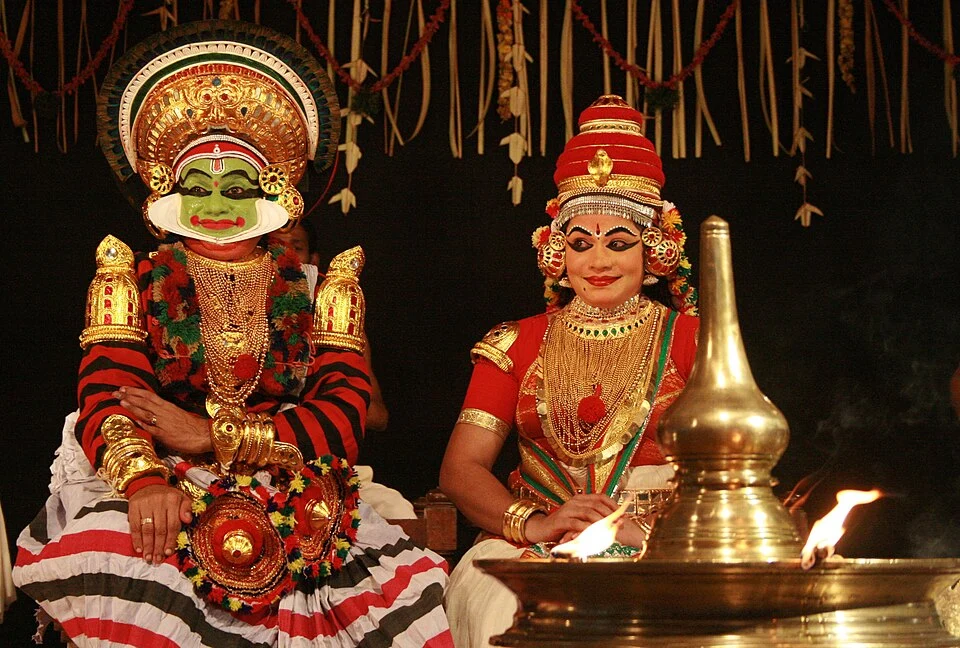
A character stands on stage, almost motionless. The eyes shift, the eyebrows rise, and a carefully controlled expression begins to reveal an entire story. There is no rush to move to the next scene. In Koodiyattam, even a single moment can become an elaborate act of storytelling.
Performed in Kerala for centuries, Koodiyattam is a traditional Sanskrit theatre form known for its expressive acting, intricate gestures and distinctive musical accompaniment. Its performers use an extraordinary combination of eye movements, facial expressions and body language to bring characters from ancient Sanskrit dramas to life.
What makes this theatre tradition particularly remarkable is the discipline behind every movement. Performers spend years mastering its techniques, preserving an art form in which storytelling depends as much on expression and gesture as it does on words.
The Origins and History of Koodiyattam
Koodiyattam, also written as Kutiyattam, is believed to have originated more than 2,000 years ago. It developed in Kerala as a distinctive form of Sanskrit theatre, combining classical Indian dramatic traditions with the region’s own performance practices.
The art form draws inspiration from Sanskrit plays and stories associated with Hindu epics such as the Ramayana and Mahabharata. Over generations, performers developed specialised techniques for presenting these stories through expressions, gestures, dialogue and music.
Koodiyattam was traditionally performed within temple complexes in specially constructed theatres called Koothambalams. Its presentation was closely connected with temple traditions, and access to performances was historically restricted in certain settings.
The art form was traditionally passed down through particular performing communities and families. Teachers trained students through a demanding system of instruction, preserving performance techniques and knowledge that could take many years to master.
Today, institutions such as Kerala Kalamandalam and Margi have expanded training and performance opportunities for wider audiences.
The Art of Expression: How Koodiyattam Tells a Story
One of the most distinctive features of Koodiyattam is its detailed language of expression. Performers use their eyes, facial muscles, hands and body movements to communicate the emotions and thoughts of the characters.
Two important techniques are Neta Abhinaya and Hasta Abhinaya.
Neta Abhinaya: The Language of the Eyes
In Koodiyattam, the eyes play a central role in storytelling. Known as Neta Abhinaya, this technique involves precise eye movements that communicate different emotions and reactions.
A performer can use the direction, movement and intensity of the eyes to express surprise, fear, anger, happiness or sorrow. These expressions are carefully practised and require considerable control.
For audiences, watching this technique is one of the most fascinating parts of a Koodiyattam performance. Even without understanding the Sanskrit dialogue, viewers can appreciate how the performer communicates through facial expression.
Hasta Abhinaya: Storytelling Through Hand Gestures
Hasta Abhinaya refers to the use of hand gestures to communicate meaning. Different hand positions and movements represent objects, actions, characters and ideas.
These gestures form part of a structured performance language, allowing actors to communicate detailed aspects of a story. Combined with facial expressions and body movements, they create a theatrical experience in which even small movements carry meaning.
Pakarnnattam: Becoming Different Characters
Another interesting feature of Koodiyattam is Pakarnnattam, a technique in which a performer takes on different characters within a scene.
Rather than relying on multiple actors to represent every character, one performer may transform their expressions, posture and movements to portray different roles. This requires strong acting skills and an understanding of each character’s personality.
These techniques demonstrate the concentration and control required in this traditional theatre form.
The Performers and Traditional Musical Instruments
Koodiyattam traditionally brings together performers from different communities, each with a specialised role in the presentation.
Chakyars: Traditionally, male performers from the Chakyar community portray important male characters and carry much of the acting responsibility. Their training includes detailed facial expressions, gestures and character interpretation.
Nangiars: Women from the Nambiar community, traditionally known as Nangiars or Nangiarammas, perform female roles in Koodiyattam. They also contribute to the musical presentation through cymbals and vocal accompaniment.
Nambiars: Nambiar men traditionally play the Mizhavu, the principal percussion instrument used in Koodiyattam.
The Mizhavu: The Sound Behind the Performance
The Mizhavu is a large copper percussion instrument that produces a deep, resonant sound. It plays an important role in supporting the rhythm and dramatic movement of a Koodiyattam performance.
Traditionally played by Nambiar men, the instrument accompanies the performers and helps shape the atmosphere of different scenes. Its rhythms can support moments of tension, emotional expression and dramatic action.
The Mizhavu is not simply background music. It is an essential part of the theatrical presentation, working closely with the actors’ movements and expressions.
Inside a Traditional Koothambalam
The traditional setting of Koodiyattam is as distinctive as the performance itself. It is traditionally presented in a theatre known as a Koothambalam, usually located within a temple complex.
These theatres are designed specifically for traditional performing arts. Their architecture reflects Kerala’s wooden building traditions, with carefully planned interiors and a raised performance platform.
An oil lamp placed on the stage is an important feature of the traditional setting. Its light creates a focused atmosphere, while the surrounding space allows the audience to concentrate on the performers.
The Koothambalam is more than a performance hall. It represents the historical relationship between temple architecture, religious traditions and Kerala’s classical theatre.
Not every temple has a Koothambalam, and access to these spaces depends on the temple’s arrangements and customs.
How a Koodiyattam Performance Unfolds
A Koodiyattam performance does not follow the pace of modern theatre. Instead of moving quickly from one scene to another, it often gives performers considerable time to explore the emotions, thoughts and motivations of a character.
Some traditional performances include different stages of presentation, such as Purappadu, an introductory presentation by the performer, and Nirvahanam, in which a character’s background and experiences are elaborated through expressive acting.
The Vidushaka, or comic character, is another important feature of Koodiyattam. Usually performed by a Chakyar, this character can explain aspects of the story and introduce humour and social commentary. The Vidushaka may use Malayalam, helping audiences understand parts of a performance even when the main dramatic text is in Sanskrit.
A traditional Koodiyattam production can take an unusually long time to complete. A single act may extend over several days, and historical full-length performances have been known to continue for much longer.
This detailed approach is one of the reasons Koodiyattam requires such specialised training. Performers must develop precise control over breathing, facial muscles, eye movements and body language.
Where Can You Experience Koodiyattam in Kerala?

Travellers interested in Kerala’s traditional performing arts can explore several institutions and cultural centres associated with Koodiyattam. Some focus on training and research, while others also organise performances and cultural programmes.
1. Kerala Kalamandalam, Cheruthuruthy
Located at Cheruthuruthy in Thrissur district, Kerala Kalamandalam is one of India’s important institutions for preserving and teaching Kerala’s classical performing arts.
Established through the efforts of poet Vallathol Narayana Menon and his associates, the institution has played a significant role in the development of traditional art education.
Koodiyattam is among the performing arts taught here, alongside Kathakali, Mohiniyattam and other disciplines. Its structured training system has helped make traditional art education accessible to students beyond the communities that historically practised these forms.
For visitors interested in understanding Kerala’s classical arts, Kerala Kalamandalam is a worthwhile cultural destination. Check in advance whether performances or visitor programmes are available during your visit.
2. Margi, Thiruvananthapuram
Margi is a cultural organisation in Thiruvananthapuram dedicated to preserving and promoting Kerala’s traditional performing arts.
The institution is particularly associated with Kathakali and Koodiyattam. Through training programmes and performances, it has contributed to keeping these classical theatre traditions active among contemporary audiences.
Margi is an interesting place for travellers who want to explore Kerala’s traditional theatre while visiting the state capital. Its activities include training and cultural presentations, although public performance schedules can vary.
3. Ammannur Gurukulam, Irinjalakuda
Irinjalakuda in Thrissur district is an important centre for Koodiyattam traditions. The Ammannur Chachu Chakyar Smaraka Gurukulam is associated with the preservation and teaching of this ancient theatre form.
The institution follows a traditional approach to training, passing performance techniques from experienced teachers to students. It is closely connected with the legacy of the Ammannur school of Koodiyattam.
For visitors interested in the art form, Irinjalakuda offers an opportunity to explore an important part of Kerala’s theatre heritage. Contact the institution in advance to enquire about performances or visitor arrangements.
4. Traditional Koothambalams at Temple Centres
Some of Kerala’s traditional temple theatres continue to be associated with Koodiyattam performances.
The Koothambalam at Koodalmanikyam Temple in Irinjalakuda and the traditional performance spaces associated with Vadakkumnathan Temple in Thrissur are among the important locations connected with this theatre tradition.
These venues help visitors understand the historical relationship between Koodiyattam and Kerala’s temple culture. However, performances are not necessarily available every day, and access to temple performance spaces may be subject to specific arrangements.
If you are planning your visit around a performance, check the local programme before travelling.
Things to Know Before Watching a Koodiyattam Performance
Watching Koodiyattam can be a different experience from attending a conventional theatre show. A little preparation can help you appreciate the performance more fully.
- Check the performance schedule: Koodiyattam is not performed daily at every institution or temple. Confirm the date and venue before visiting.
- Understand the language: Much of the dramatic text is in Sanskrit. Some explanations and sections, particularly those involving the Vidushaka, may use Malayalam.
- Allow enough time: Traditional presentations can be lengthy. Shorter demonstrations or selected scenes may be available in certain cultural programmes.
- Learn about the story: Knowing the basic story or characters beforehand can help you follow the performance.
- Follow venue rules: Photography, recording and entry arrangements differ between institutions and temples.
- Respect the performance: Avoid unnecessary movement or conversations during the presentation, as the art depends on subtle expressions and focused attention.
For first-time viewers, a shorter introduction or demonstration may be a useful way to become familiar with the acting techniques before attending a longer traditional performance.
Discover the Cultural Soul of Kerala
Koodiyattam offers a rare opportunity to explore Kerala’s artistic heritage through a theatre tradition that has survived for centuries. Its expressive acting techniques, traditional instruments, temple theatres and demanding training system reveal the depth of knowledge preserved by generations of performers.
From the cultural institutions of Thiruvananthapuram and Cheruthuruthy to the traditional performance centres of Irinjalakuda and Thrissur, Kerala offers several ways to learn about this remarkable art form.
For travellers looking beyond the state’s familiar landscapes, experiencing Koodiyattam can add a meaningful cultural dimension to a Kerala holiday. It is a reminder that the state’s heritage is not found only in its monuments and natural surroundings, but also in the living traditions that continue to connect its past with the present.


