
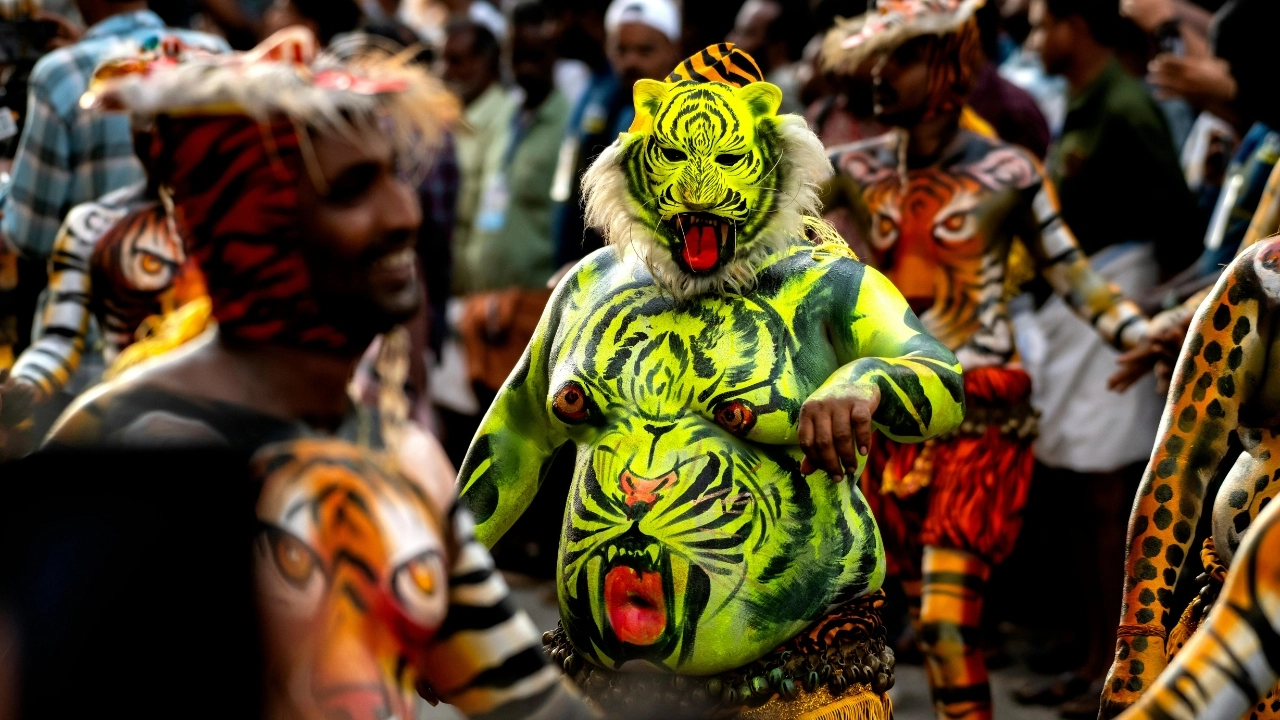
Kerala is known for its calm backwaters, green hill stations, and golden beaches. But once a year, the state swaps its quiet charm for loud drums, painted bodies, and street energy. That happens during Pulikali – the Tiger Dance of Kerala.
If you think you know Kerala only through houseboats and tea plantations, Pulikali will surprise you. It is raw, joyful, and unforgettable.
What Exactly is Pulikali?
The name Pulikali comes from two Malayalam words: Puli (tiger) and Kali (play or performance). So it literally means “tiger play.”
In this folk art, performers paint their entire bodies like tigers and hunters. Then they dance, jump, and act out hunting scenes on public streets. There is no stage, no curtains, no tickets. The whole city becomes the theatre.
Pulikali is not a classical art like Kathakali. It is a street celebration – loud, lively, and full of community spirit. And it happens every year during Onam, Kerala’s biggest harvest festival.
The best place to see it is Thrissur, often called the cultural capital of Kerala. The main action takes place around the Swaraj Round and the historic Thekkinkadu Maidan.
A Quick Look at History

Pulikali is nearly 200 years old. It is closely linked to the former Kingdom of Cochin.
Local traditions say that Maharaja Sakthan Thampuran, the powerful ruler of Thrissur, encouraged this dance. He loved public celebrations that showed courage and joy. Over time, what started as a royal‑era street performance became a beloved folk tradition.
Today, Pulikali is a matter of pride for local communities. Different teams compete to create the most realistic tigers and the most energetic performances.
When Does Pulikali Happen?
Pulikali is part of the Onam festival and is generally held during the later days of celebrations in Thrissur. Since dates vary annually, local authorities announce the official schedule each year according to the festival calendar.
If you are planning to attend, look up local news or the Kerala Tourism website a few weeks before Onam.
Pulikali and the Spirit of Onam
To understand Pulikali, you need to know a little about Onam.
Onam celebrates the return of King Mahabali, a legendary ruler who brought peace and prosperity to Kerala. The festival lasts ten days and includes flower carpets (pookalam), grand feasts (onasadya), snake boat races, and gentle dances.
Most Onam traditions are calm and devotional. But Pulikali is the loud, wild cousin of the festival. It captures the pure fun of Onam – the part where people just want to laugh, shout, and enjoy together.
How Ordinary People Become Tigers
The most amazing part of Pulikali happens before the dance even starts.
On the morning of the event, performers gather for hours of body painting. Many shave their bodies so the paint sits smoothly. Then artists use bright colours – yellow, orange, black, white, and red – to draw tiger stripes, muscles, and fierce faces.
How long does it take?
Preparation and body painting may take several hours, depending on the costume and design complexity. Some simpler designs take less time; elaborate ones can take much longer. Different troupes report different durations, so there is no single fixed number.
But paint is not enough. Performers also wear:
- Tiger masks
- Artificial fangs
- Bells around their waist
- A long cloth tail
By afternoon, ordinary men and women have turned into prowling tigers ready to take over the streets.
(Note: Historically a male‑dominated art, but today some troupes include women performers as well.)
What It Feels Like to Watch Pulikali

Imagine thousands of people lining both sides of a road. Families, photographers, tourists, and vendors fill every available space. The air smells of sweat, snacks, and excitement.
Then you hear it – the drums.
The chenda, thakil, and udukku drums begin a rhythm that you feel in your chest. And then the tigers arrive.
They leap. They stalk. They pretend to attack hunters. Some perform funny skits that make children laugh. Others show off their most realistic tiger moves.
The crowd cheers. Cameras flash. Children scream with joy. It is not a polished or commercial show. It is real, raw, and absolutely thrilling.
And the best part? You can stand just a few feet away from the performers. No glass barrier, no VIP section. Just pure celebration.
Why Travelers from Around the World Love It
Pulikali is not famous by accident. It offers something that few other festivals can match.
- A visual feast – Where else can you see dozens of “tigers” dancing together on a city street?
- Authentic folk culture – This is not made for tourists. It is made by local communities for their own joy. That honesty shines through.
- Limited-time magic – You cannot see Pulikali at any time of the year. It only happens during Onam. That makes it special.
- Thrissur’s unique spirit – Thrissur is already a city of festivals (Thrissur Pooram is legendary). Pulikali adds another layer to its cultural richness.
Practical Tips for First‑Time Visitors (Including Local Logistics)
A little planning makes the experience much smoother.
Tip | Why It Helps |
Reach early (by 2 PM) | Streets fill up fast. Early arrival gives you a good spot. |
Wear light clothes | Kerala during Onam is warm and humid. Cotton is your friend. |
Carry water | You will be standing and walking for hours. Stay hydrated. |
Keep your camera ready | The best photo moments happen suddenly – when a tiger leaps or the drums start. |
Expect road closures | Many roads around Swaraj Round are blocked for the event. |
Parking is difficult | Avoid driving directly to the venue. Park farther away and walk. |
Public transport is crowded | Buses and auto‑rickshaws fill up quickly. Plan extra time. |
Book hotels early | The Onam week sees huge demand. Do not wait until the last day. |
Entry is free. No tickets needed. Just show up and enjoy.
How to Reach Thrissur for Pulikali
- By Air: Cochin International Airport is about 50–60 km away. From there, take a taxi or bus to Thrissur.
- By Train: Thrissur Railway Station is well‑connected to Kochi, Bangalore, Chennai, and Mumbai.
- By Road: Regular buses and taxis run from Kochi (2 hours), Palakkad (1.5 hours), and Kozhikode (3 hours).
Book your transport and stay well in advance. During Onam, last‑minute options become very limited.
Other Things to See Around Thrissur
Make your trip richer by visiting these nearby places:
- Vadakkunnathan Temple – An ancient Shiva temple right where Pulikali happens.
- Athirappilly Waterfalls – Called the “Niagara of India.” About an hour away.
- Shakthan Thampuran Palace – A museum that tells the story of Thrissur’s royal past.
- Kerala Kalamandalam – A renowned centre for classical arts such as Kathakali.
- Guruvayur Temple – One of South India’s most sacred pilgrimage spots, about 30 km from Thrissur.
FAQ About Pulikali in Kerala
What is Pulikali famous for?
Pulikali is famous for its spectacular body art, where performers paint themselves as tigers and dance through the streets of Thrissur. It is one of Kerala’s most visually striking folk traditions.
Why is Pulikali celebrated during Onam?
Pulikali adds a playful, energetic element to Onam. While most Onam traditions are devotional or artistic, Pulikali brings loud music, humour, and street‑level excitement – celebrating the festive spirit of togetherness.
When is Pulikali celebrated?
Pulikali is held during Onam, usually in the later days of the festival. The exact date changes every year, so check the official schedule announced by Thrissur authorities.
Is Pulikali free to watch?
Yes. There is no entry fee. Anyone can stand along the streets and watch.
Where does Pulikali happen in Thrissur?
The main performances take place around the Swaraj Round and the Thekkinkadu Maidan, near the Vadakkunnathan Temple.
Final Thoughts
Pulikali is more than a tiger dance. It is a celebration of community joy.
Watching Pulikali offers visitors a memorable glimpse into Kerala’s living festival culture. The painted tigers, the thunderous drums, and the excited crowds turn Thrissur into an open‑air theatre for one unforgettable afternoon.
So if you ever plan a trip to Kerala during Onam, do not just book a houseboat. Head to Thrissur. Stand on the street. Let the atmosphere surround you. And watch the tigers dance.
You will not forget it.
Planning to experience Pulikali during Onam? Explore Kerala tour packages and discover Thrissur’s vibrant festival culture firsthand.


