
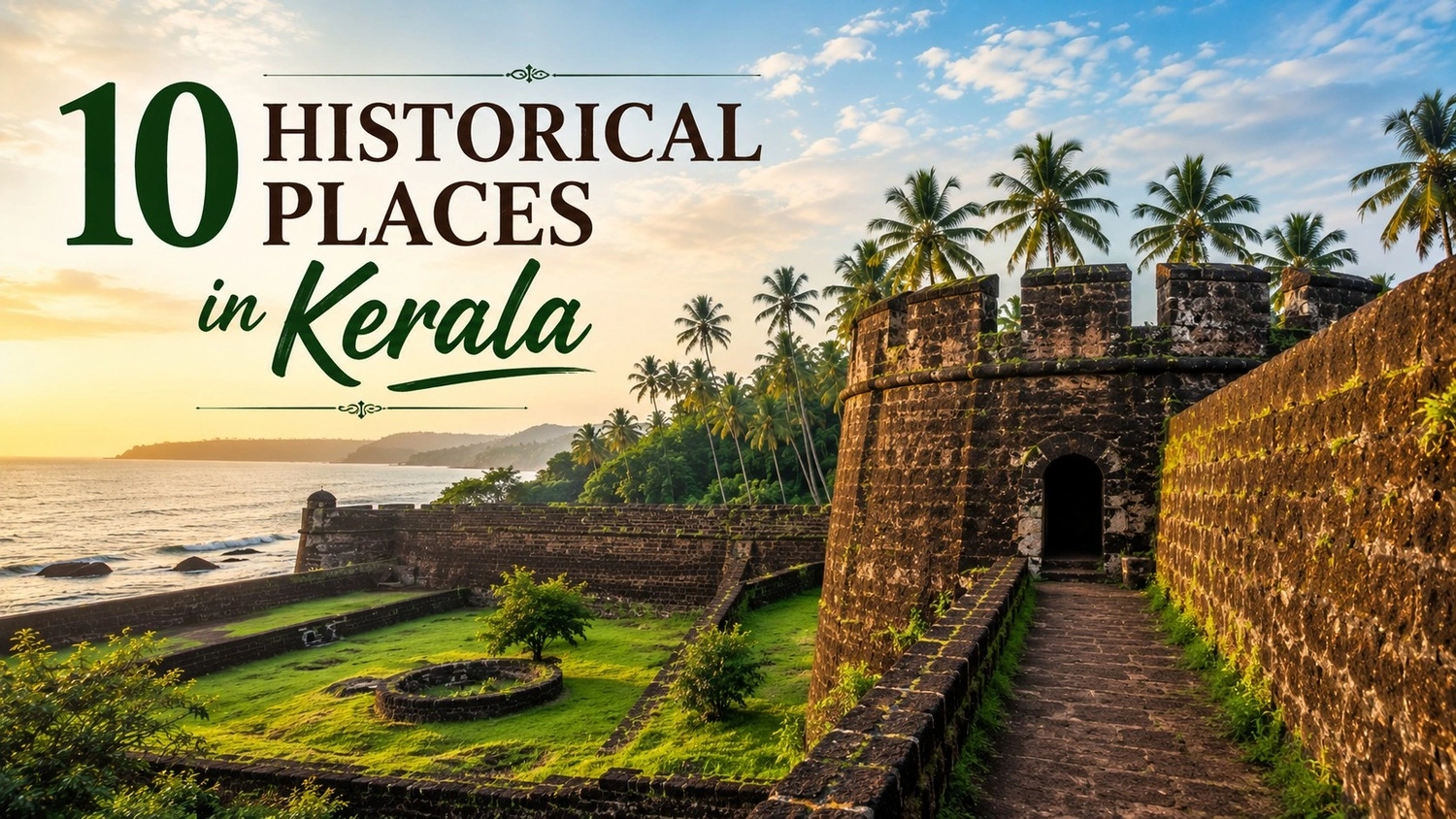
Think Kerala is only about backwaters and beaches? These ten heritage sites – from a 17th‑century fort on the Arabian Sea to a cave with 8,000‑year‑old carvings – will change your mind.
Most travelers come to Kerala for the houseboats, the tea estates, and the slow rhythm of the backwaters. And that’s fine. But if you stay only on the water, you miss the real story of this state.
For over two thousand years, Kerala was the center of the global spice trade. Romans, Arabs, Chinese, Portuguese, Dutch, and British all arrived on this coast. They built forts, palaces, and trading posts. They left behind not just buildings but a layered culture you can still walk through today.
This list is for the traveler who wants more than a postcard. Each place is accessible, historically significant, and rewarding. Read on – and plan at least a few of them into your Kerala itinerary.
1. Fort Kochi – A Colonial Neighbourhood That Still Lives

Fort Kochi is not a single monument. It’s an entire neighbourhood where Portuguese houses, Dutch warehouses, British churches, and Jewish synagogues sit side by side. The best way to see it is on foot, early morning or late afternoon.
Travelers interested in Kerala’s colonial heritage can also explore our detailed guide to Kerala’s historic forts and colonial architecture
What to see:
- Chinese fishing nets – still operated by local fishermen
- Mattancherry Palace (also called Dutch Palace) with Hindu murals
- Paradesi Synagogue – active since the 16th century
- Jew Town – a lane of antique shops and spice stalls
Practical info:
Open daily. No entry fee for the streets. Palace and synagogue charge small fees (₹20–₹100). Nearest airport: Cochin International Airport (about 45 minutes by road). Best months: October to March.
2. Bekal Fort – The Largest Fort in Kerala

Bekal Fort sits on a cliff overlooking the Arabian Sea in Kasaragod district. Built in the mid‑17th century, it was used for coastal defence. The laterite walls, observation towers, and a tunnel leading to the sea are all intact.
The sunset view from the fort is genuinely impressive – the sky turns gold and orange over the water. Many travelers combine Bekal with a stay at a nearby backwater resort.
Practical info:
Entry ₹25 for Indians, ₹200 for foreigners. Open 8 AM to 6 PM. Best visited late afternoon for light and temperature.
3. Padmanabhapuram Palace – Wooden Architecture at Its Finest

This palace lies just across the border in Tamil Nadu, but it was the capital of Kerala’s Travancore kingdom and is still managed by the Kerala government. Built mostly from teak, rosewood, and jackfruit, the palace has no nails in many sections.
Highlights:
- The royal audience hall has a floor made of burnt coconut shells and egg white
- Secret escape passages
- A museum of royal weapons and furniture
Practical info:
Closed Mondays. Entry ₹30 (Indians), ₹200 (foreigners). About 60 km from Thiruvananthapuram. Allow two hours.
4. Edakkal Caves – Prehistoric Rock Art in Wayanad
Edakkal is not a true cave but a natural rock shelter formed by a huge boulder wedged between two cliffs. Inside, you’ll find stone carvings – human figures, animals, and symbols – believed to be around 8,000 years old.
Important correction: These prehistoric petroglyphs are among the most important rock carvings discovered in South India. They offer a rare window into Neolithic life in this region.
Reaching the caves requires a 45‑minute uphill trek through coffee plantations. Wear proper shoes and carry water. The view from the top is worth the climb.
Practical info:
Closed Mondays. Entry ₹20 (Indians), ₹50 (foreigners). Best from November to March. Avoid the monsoon – the path becomes slippery.
5. Hill Palace Museum – Royal Collections on a Hillside

Spread over 52 acres, Hill Palace was the official residence of the Kochi royal family. Today, it is the largest archaeological museum in Kerala. The complex includes 49 traditional buildings, a deer park, and a heritage garden.
What you will see:
- Royal crowns and ornaments
- 19th‑century weapons
- Palm‑leaf manuscripts
- Sculptures and antique furniture
Practical info:
Closed Mondays. Entry ₹40 (Indians), ₹200 (foreigners). Located in Tripunithura, 12 km from Ernakulam. Plan 2–3 hours.
6. Palakkad Fort – Tipu's Fortress in the City Center

Built by Hyder Ali of Mysore in 1766 and later used by Tipu Sultan, this granite fort is remarkably well preserved. A wide moat surrounds the walls. Inside, the grounds are now a public space – locals jog here in the mornings.
There is no museum inside, but the structure itself is the attraction. It is one of the few forts in Kerala that has not been turned into a crowded tourist spot.
Practical info:
Free entry. Open daily 8 AM to 6 PM. Located in the heart of Palakkad town. Easily reached by bus or taxi service in Kerala.
7. Muziris Heritage Project – India's Lost Ancient Port

Muziris was one of the most important ports of the ancient world. Roman writers described it as a place of great wealth, overflowing with pepper and pearls. In the 14th century, a flood changed the course of the river, and the port disappeared.
Today, the Muziris Heritage Project preserves what remains. You can visit:
- Paliam Palace (home of the prime ministers to the Kochi kings)
- Cheraman Juma Masjid – India’s first mosque, built in 629 CE
- Kottappuram Fort ruins
- Ancient synagogues and churches
Practical info:
Multiple sites are spread across Kodungallur and North Paravur. Entry fees range from free to ₹50 per site. Best explored with a local guide or a full day set aside. About an hour from Kochi by road.
8. Krishnapuram Palace – Home to Kerala's Largest Mural
Built in the 18th century by the Travancore king Marthanda Varma, this palace is most famous for the Gajendra Moksham mural – a 49‑square‑meter painting of an elephant praying to Lord Vishnu. It is one of the largest surviving murals in Kerala.
The palace also displays a flexible sword called the Kayamkulam sword, along with bronze sculptures and stone inscriptions from the 8th century.
Practical info:
Closed Mondays. Entry ₹20 (Indians), ₹100 (foreigners). Located in Kayamkulam, Alappuzha district. Two hours from Kochi by road.
9. Thalassery Fort – British Military Architecture on a Cliff
Built by the British East India Company in 1708, this fort sits on a rocky cliff overlooking the sea. It was designed to protect their spice trade from French and Mysorean forces. The fort has massive stone walls, secret tunnels, and a small lighthouse.
After visiting, walk down to the pier and try the local speciality – Thalassery biriyani. It is different from other Indian biriyanis, influenced by Arab traders who landed at this very coast.
Practical info:
Entry ₹10 (Indians), ₹100 (foreigners). Open 8 AM to 6 PM. Located in Thalassery town, Kannur district. Nearby airport: Kannur International (20 km).
10. Kottukkal Cave Temple – A Quiet Rock‑Cut Temple Near Kollam
Most travelers skip this place, which is exactly why you should consider it. Kottukkal (also called Kaltrikkovil) is not a single cave but two rock‑cut shrines – one for Shiva and one for Vishnu – carved from a massive natural boulder.
There is no brick or mortar. The entire structure is cut from live rock, dating back to the 8th or 9th century. It is peaceful, rarely crowded, and free to enter.
Practical info:
Free entry. No fixed closing time, but daylight hours are best. Located about 50 km from Thiruvananthapuram, near Ayoor in Kollam district. Best reached by taxi or private vehicle.
Best Time to Visit These Historical Places in Kerala
Plan your trip between October and March. The weather is dry, and temperatures are comfortable for walking. Avoid the monsoon months (June to September) – especially for Edakkal Caves and outdoor forts, where pathways become slippery and unsafe.
What to pack:
- Comfortable walking shoes (cobblestones and uneven paths are common)
- Sun hat, sunglasses, and sunscreen
- Water bottle (refill where possible)
- Small cash in Indian rupees (many sites do not accept cards)
Frequently Asked Questions (FAQ)
Edakkal Caves (rock shelters) in Wayanad are among the oldest historical sites in Kerala. The prehistoric petroglyphs found here are believed to be around 8,000 years old, dating back to the Neolithic period. They are considered some of the most important rock carvings discovered in South India.
Bekal Fort in Kasaragod district is the largest fort in Kerala. Built in the mid‑17th century, it spans a vast area along the Arabian Sea coast and features massive laterite walls, observation towers, and a tunnel leading to the sea.
Yes, most historical sites in Kerala are family-friendly. Forts like Bekal and Palakkad Fort have open grounds where children can walk freely. Hill Palace Museum has a deer park and gardens. Edakkal Caves involves a moderate trek (45 minutes uphill) – suitable for older children and active families, but not recommended for very young kids or during the monsoon. Always carry water, hats, and comfortable shoes.
Several important heritage sites are within easy reach of Kochi:
- Fort Kochi (within the city) – colonial streets, Chinese fishing nets, Mattancherry Palace, Paradesi Synagogue
- Hill Palace Museum (12 km from Ernakulam) – royal collections and gardens
- Muziris Heritage Project (about 50–60 km / 1 hour drive) – ancient port ruins, India's oldest mosque, Paliam Palace
- Krishnapuram Palace (about 2 hours south) – famous for the giant Gajendra Moksham mural
The best time to visit Kerala's historical places is from October to March. The weather is dry, sunny, and comfortable for walking through forts, palaces, and cave sites. Avoid the monsoon months (June to September) – especially for Edakkal Caves and outdoor forts, where paths become slippery and unsafe.
Final Thoughts
Kerala’s history is not locked in museums behind glass cases. You can touch the laterite walls of a 17th‑century fort. You can stand inside a rock shelter where someone carved a hunting scene 8,000 years ago. You can walk down a lane where Jewish, Dutch, and Portuguese traders once argued over pepper prices.
These ten places offer a real, unpolished look at a state that has always looked outward – to the sea, to the world. Whether you have 2 days or 2 weeks, pick 2 or 3 from this list. You will come away with a much deeper understanding of Kerala.


